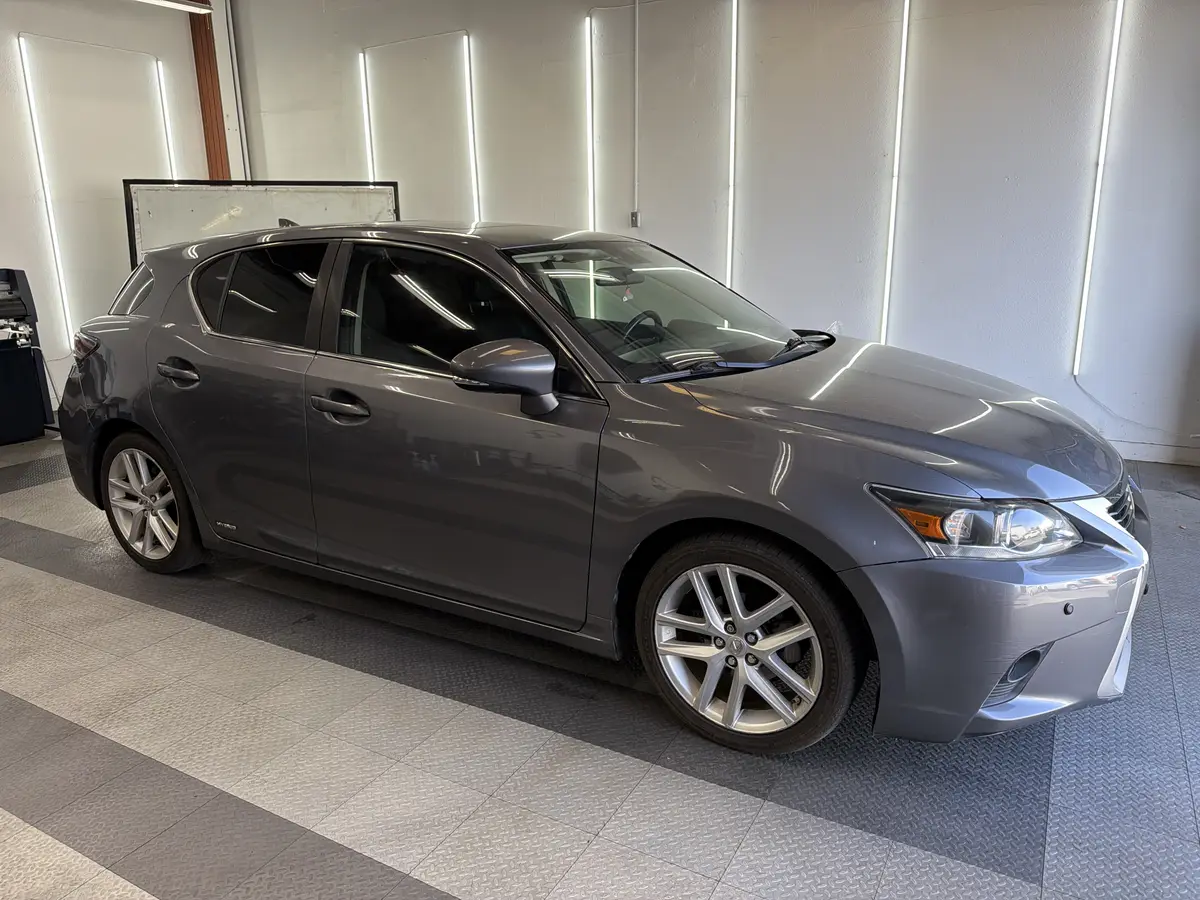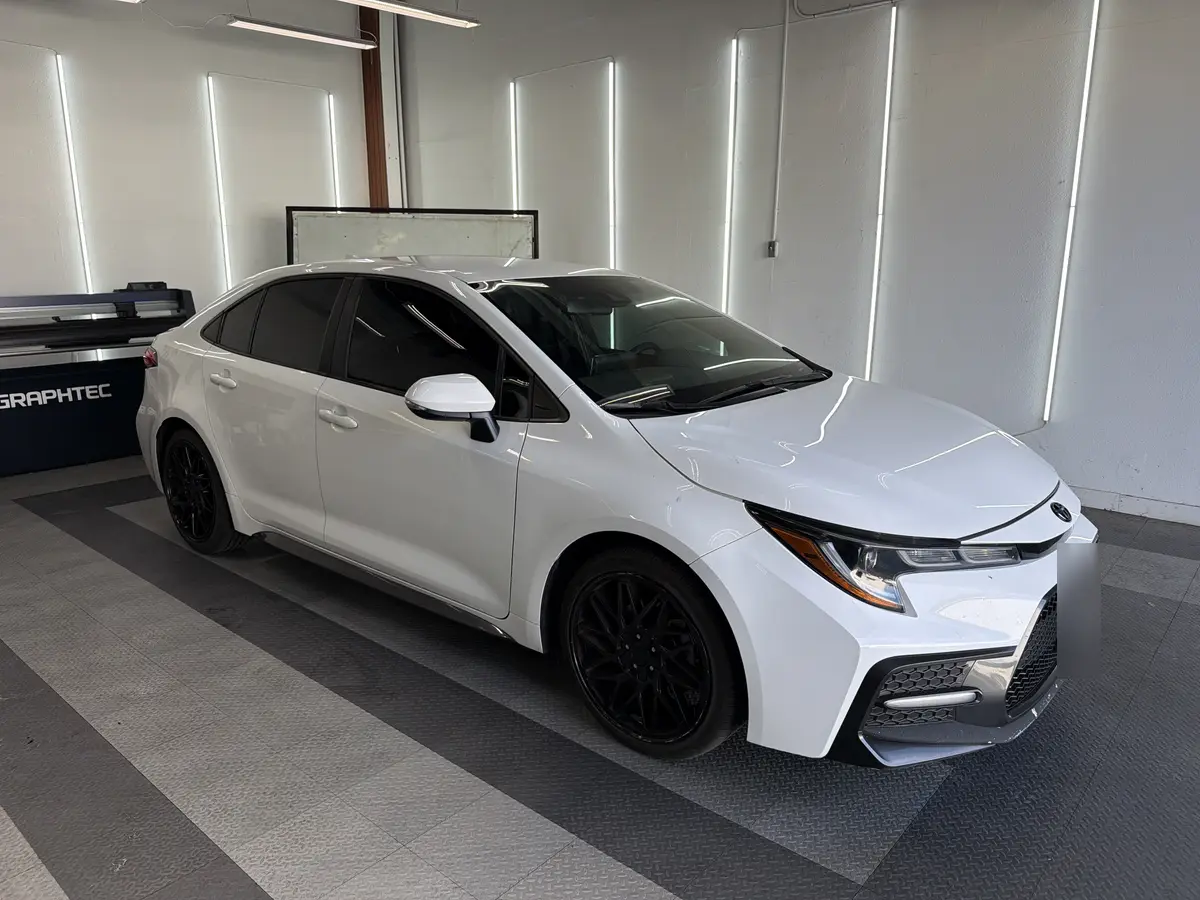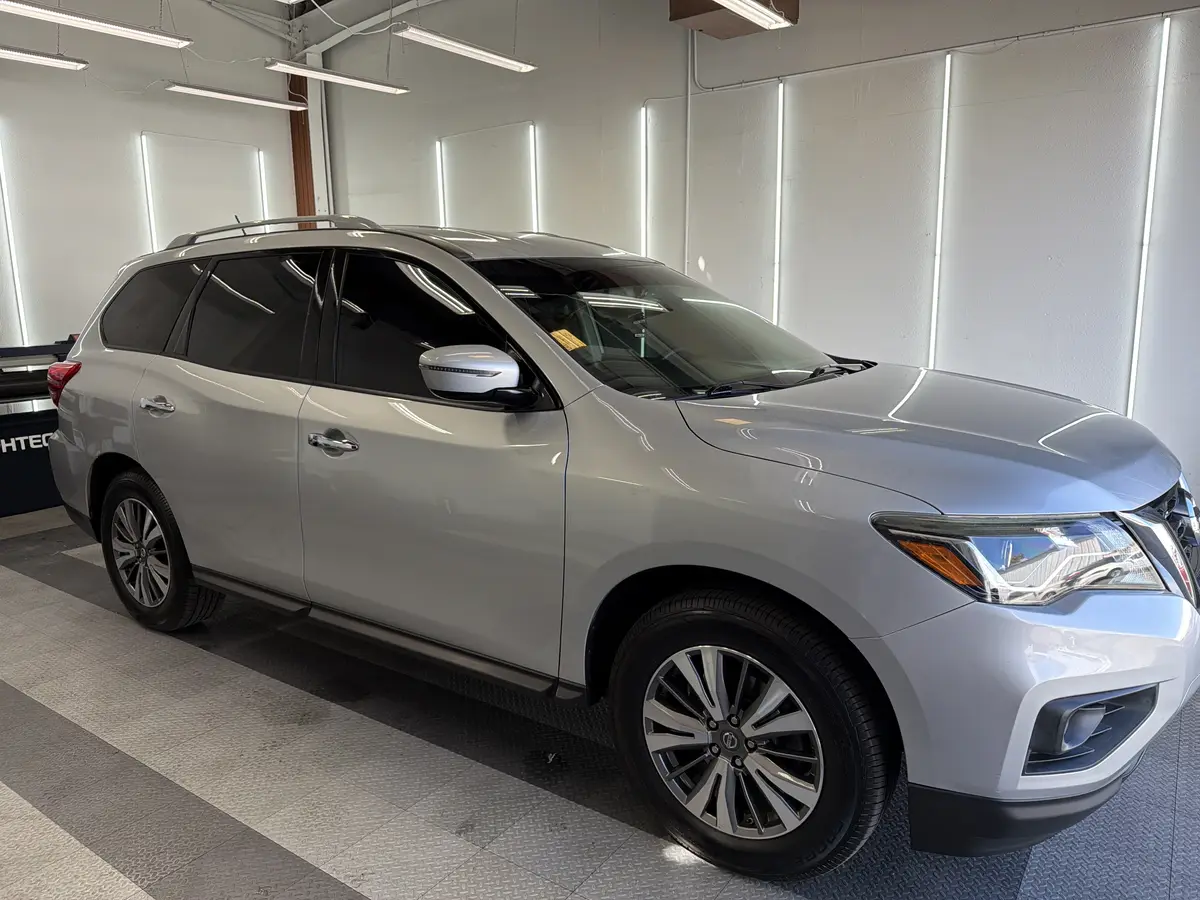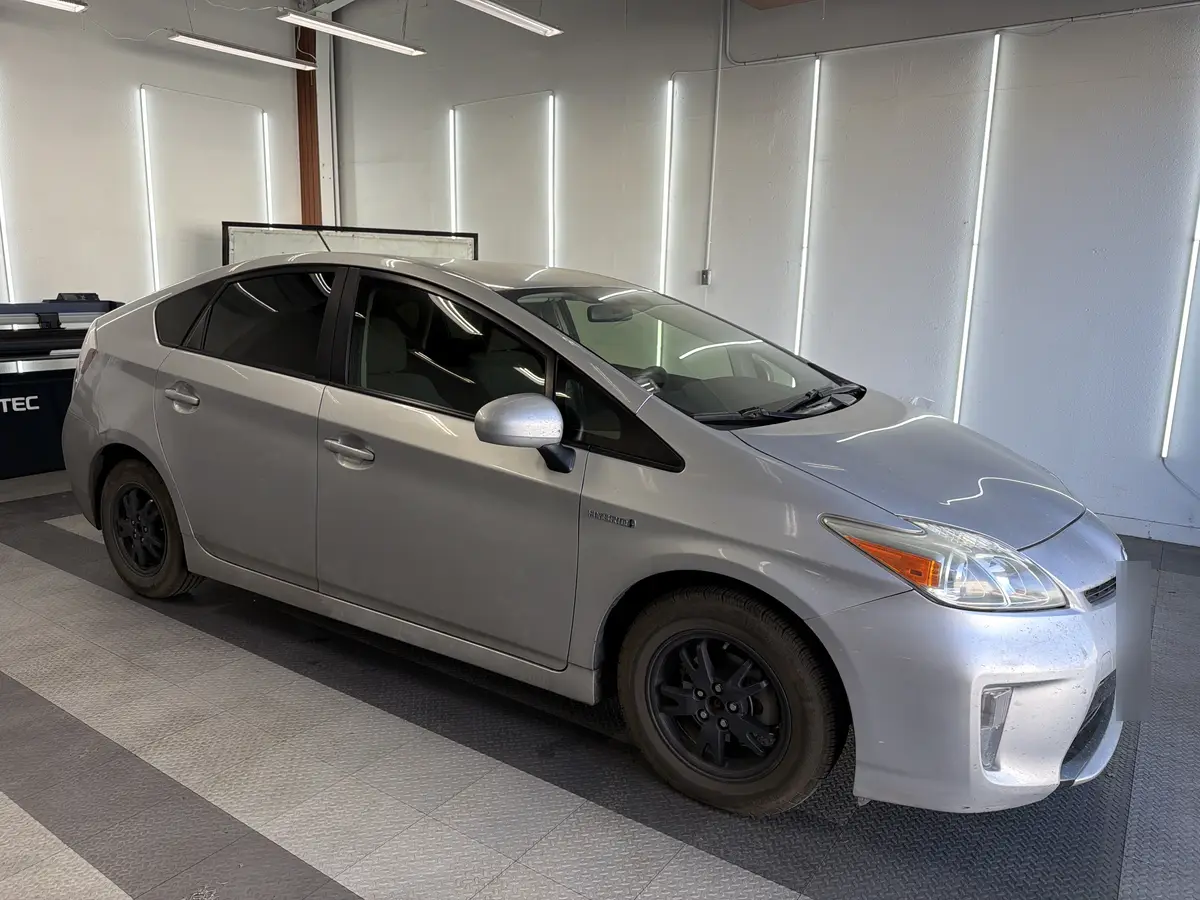
Carbon and ceramic are the two non-metallic premium film familiesthat have replaced dyed and metalized tints at the top of the automotive window-film market. Carbon uses dispersed carbon particles that absorb solar energy; ceramic uses nano-ceramic particles that both absorb and reflect infrared radiation. Neither contains metal, so neither interferes with cellular, GPS, keyless entry, or TPMS signals.
The practical difference is infrared heat rejection. On the Avery Dennison Encore product data sheet, the carbon-tier film (Encore) measures 32–52% Infrared Energy Rejection (IRER) across its VLT range; the ceramic tier (Encore Supreme) measures 56–64% IRER; the top ceramic-IR tier (Encore Supreme IR) measures 65–66% IRER. UV rejection sits at 99 percent for every tier. Darkness (VLT) is independent of all of these — a 70 percent ceramic film still rejects most of the infrared load that a 70 percent dyed film does not.
Understanding Window Film Technology
Before diving into the carbon vs ceramic comparison, it helps to understand where these films fit in the broader window tint landscape. According to the International Window Film Association (IWFA), automotive window films generally fall into these categories:
- Dyed films: Entry-level films that use dye for color and light absorption. Affordable but limited heat rejection and prone to fading.
- Metalized films: Use metal particles to reflect heat. Good performance but can interfere with electronics.
- Carbon films: Use carbon particles for heat absorption without metal. Non-reflective appearance with good performance.
- Ceramic films: Use nano-ceramic particles for maximum heat rejection. Premium performance with excellent clarity.
Carbon and ceramic films represent the two premium non-metallic options available today. We previously compared ceramic tint versus regular (dyed) tint—now let's see how ceramic stacks up against its closest competitor: carbon.
What Is Carbon Window Tint?
Carbon window tint is constructed from a polyester film base infused with dispersed carbon particles. The particles are non-metallic and non-conductive, so a carbon film does not interfere with cellular signals, GPS, Bluetooth, keyless entry, or tire pressure monitoring — the practical advantage over the older metalized films carbon largely replaced.
Carbon particles reject infrared energy primarily by absorption. On the Avery Dennison Encore carbon film we stock, infrared energy rejection (IRER) ranges from 32 percent at the lightest 50 VLT to 52 percent at the darkest 5 VLT, and total solar energy rejected (TSER) ranges from 33 to 59 percent across the same shades. Carbon films also carry a distinctive matte-black appearance, which many drivers prefer to the slight optical gloss of a ceramic film.
What Is Ceramic Window Tint?
Ceramic window tint represents the latest advancement in window film technology. Instead of carbon particles, ceramic films use nano-ceramic particles—microscopic ceramic compounds that are non-metallic, non-conductive, and highly effective at blocking infrared radiation.
The key difference is in how ceramic film works. While carbon particles primarily absorb solar energy, ceramic particles both absorb and reflect infrared radiation. This dual-action mechanism allows ceramic films to reject significantly more heat while allowing more visible light to pass through—a combination that seemed impossible with older film technologies.
Published rejection figures from ceramic manufacturers (Avery Dennison, SunTek, Llumar, 3M) land in similar ranges because the underlying nano-ceramic chemistry is similar across the top of the category. A premium ceramic film at 35 percent VLT typically rejects 55–65 percent of total solar energy (TSER) and 55–66 percent of infrared energy (IRER); the headline “up to 95 percent” marketing you'll see on datasheets is Selective Infrared Rejection (SIRR), a favourable slice of the IR band that is always the largest figure. The Avery Dennison Encore table used here reports both, which is why we quote both. See ceramic window tinting in Sacramento for the shade-by-shade numbers from the shop's own stocked line.
Carbon vs Ceramic Tint: Detailed Comparison
Heat Rejection Performance
Heat rejection is the headline difference between the two film families. Two measurements get reported — total solar energy rejected (TSER), which is the whole of what the sun delivers, and infrared energy rejection (IRER), which is the infrared band alone — and resellers tend to quote whichever is larger. Both are reported here from the Avery Dennison Encore PDS at the 35 percent VLT shade most customers actually buy:
- Carbon (Encore 35): 40% TSER, 36% IRER
- Ceramic (Encore Supreme 35): 54% TSER, 59% IRER
- Ceramic-IR (Encore Supreme IR 35): 57% TSER, 65% IRER
Avery Dennison notes the figures are calculated on 1/4" (6mm) clear glass by NFRC methodology with LBNL Window 5.2, subject to variation; actual results on a specific vehicle will differ with glass thickness and tint. On a 105°F Sacramento afternoon, the National Weather Service reports vehicle interior temperatures can reach 150–170°F in direct sun — the gap between a carbon film rejecting 36% IRER and a ceramic-IR film rejecting 65% IRER is the difference the AC load most often responds to.
UV Protection
Both carbon and ceramic films excel at UV protection, which is important for both health and interior preservation:
- Carbon tint: Blocks 95-99% of UV rays
- Ceramic tint: Blocks 99%+ of UV rays
The Skin Cancer Foundation recognizes quality window film as an effective UV protection measure. Both carbon and ceramic provide excellent protection from UVA and UVB radiation that causes skin damage and accelerates interior fading. For UV protection alone, both film types perform comparably well.
Optical Clarity and Visibility
Ceramic tint has a notable advantage in optical clarity. At the same VLT (Visible Light Transmission) percentage, ceramic films typically offer:
- Better color neutrality: More accurate color reproduction without tinting what you see
- Reduced haze: Less cloudiness or visual distortion
- Improved night visibility: Clearer vision in low-light conditions
Carbon tint provides good visibility but can have a slight color cast depending on the product. Some carbon films have a subtle amber or warm tone that affects how colors appear through the glass. Ceramic films maintain more neutral color transmission, which many drivers prefer.
Appearance and Aesthetics
Both carbon and ceramic films offer attractive non-reflective appearances, but with subtle differences:
- Carbon tint: Distinctive matte-black finish with a slightly darker, less reflective appearance
- Ceramic tint: Clean, neutral appearance with excellent clarity from both inside and outside
Many drivers prefer the deep, rich look of carbon film, while others appreciate ceramic's ability to provide darkness without affecting the view. At the same VLT percentage, both films look similar from outside the vehicle—the aesthetic differences are subtle and often come down to personal preference.
Durability and Longevity
Both carbon and ceramic films are significantly more durable than basic dyed films, but ceramic has the edge for long-term performance:
- Carbon tint lifespan: 8-12 years with proper care
- Ceramic tint lifespan: 15+ years with proper care
Both resist the common failures seen with dyed films—purple fading, bubbling, and peeling. Carbon films are color-stable and maintain their appearance well over time. Ceramic films, however, have an advantage due to their inorganic nano-ceramic particles that don't break down under UV exposure the way organic compounds can.
Signal Interference
This is one area where carbon and ceramic perform identically: neither interferes with electronic signals. Both films are completely non-metallic, allowing the following to work normally:
- Cell phone signals and mobile data
- GPS navigation
- Bluetooth connectivity
- Satellite radio (SiriusXM)
- Keyless entry and push-button start
- Toll transponders (FasTrak)
- Tire pressure monitoring systems (TPMS)
This is a significant advantage both carbon and ceramic have over metalized films, which can block or degrade these signals due to their metallic content.
Carbon vs Ceramic Tint: Side-by-Side Comparison
| Feature | Carbon (Encore) | Ceramic (Encore Supreme) | Ceramic-IR (Encore Supreme IR) |
|---|---|---|---|
| IRER @ 35% VLT | 36% | 59% | 65% |
| TSER @ 35% VLT | 40% | 54% | 57% |
| UV Rejection | 99% | 99% | 99% |
| Color Neutrality | Slight warm tone | Neutral | Neutral |
| Signal Interference | None (non-metallic) | None (non-metallic) | None (non-metallic) |
| Film Warranty (Avery Dennison PDS) | Lifetime, original owner | Lifetime, original owner | Lifetime, original owner |
| Our shop warranty (workmanship) | Lifetime, follows the vehicle | Lifetime, follows the vehicle | Lifetime, follows the vehicle |
| Full car (starting, less windshield) | $350 | $450 | $700 |
Source: Avery Dennison Encore Automotive Window Films, Product Data Sheet Rev. 01 (2025-09-03). Avery Dennison calculates these on NFRC methodology, LBNL Window 5.2, on 1/4" (6mm) clear glass, subject to variation within industry standards — they describe the film, not a promise about a particular vehicle. Your glass, its thickness and its own factory tint all affect the finished result.
Every shade, every tier: the full PDS comparison
The table above compares the three Encore tiers at a single representative shade. Below is every row of the Avery Dennison Encore PDS — all three tiers across the entire VLT ladder, with TSER and IRER side-by-side. Carbon is grouped at the bottom (the ladder's base), ceramic in the middle, and ceramic-IR at the top. Read across any row to see what one tier gives up (or gains) at the same visible darkness.
| Tier | Shade | VLT | TSER | IRER | SIRR |
|---|---|---|---|---|---|
| Ceramic-IR | IR 05 | 5% | 65% | 65% | 93% |
| Ceramic-IR | IR 15 | 17% | 63% | 66% | 93% |
| Ceramic-IR | IR 25 | 30% | 59% | 65% | 93% |
| Ceramic-IR | IR 35 | 38% | 57% | 65% | 93% |
| Ceramic-IR | IR 45 | 45% | 55% | 65% | 92% |
| Ceramic-IR | IR 55 | 54% | 52% | 65% | 92% |
| Ceramic | 05 | 8% | 65% | 64% | 91% |
| Ceramic | 15 | 17% | 61% | 62% | 88% |
| Ceramic | 20 | 25% | 58% | 61% | 86% |
| Ceramic | 30 | 30% | 56% | 60% | 85% |
| Ceramic | 35 | 36% | 54% | 59% | 84% |
| Ceramic | 40 | 47% | 50% | 57% | 80% |
| Ceramic | 50 | 53% | 48% | 56% | 79% |
| Carbon | 05 | 5% | 59% | 52% | 74% |
| Carbon | 20 | 17% | 51% | 44% | 61% |
| Carbon | 35 | 39% | 40% | 36% | 48% |
| Carbon | 50 | 55% | 33% | 32% | 42% |
Note on the three rejection columns: TSER is Total Solar Energy Rejected across the whole spectrum — the honest heat-performance number. IRER is infrared across the full 780–2500 nm band. SIRR is infrared across a narrow 900–1000 nm slice — always the largest and most often misquoted as “heat rejection”. For why that matters see our guide to what heat-rejection numbers actually mean.
Source: Avery Dennison Encore Automotive Window Films, Product Data Sheet Rev. 01 (2025-09-03). Avery Dennison calculates these on NFRC methodology, LBNL Window 5.2, on 1/4" (6mm) clear glass, subject to variation within industry standards — they describe the film, not a promise about a particular vehicle. Your glass, its thickness and its own factory tint all affect the finished result.
Price Comparison: Is Ceramic Worth the Premium?
Ceramic tint typically costs 40-60% more than carbon tint. For a full vehicle installation, expect:
- Carbon tint: $300-$500 for a standard sedan/SUV
- Ceramic tint: $450-$800 for a standard sedan/SUV
The question is whether the extra $150-$300 is worth it. For Sacramento drivers, we believe it usually is, for several reasons:
- Climate demands: Sacramento records roughly 90 days a year with highs ≥90°F (NOAA 1991–2020 normals), so a 29-point gap in IRER between a carbon tier and a ceramic-IR tier is felt in most calendar months, not just August
- Fuel/energy savings: Better heat rejection means less AC usage, saving fuel (or EV battery range)
- Longevity: Ceramic's longer lifespan means lower cost per year of use
- Warranty value: Lifetime warranties provide peace of mind
For a deeper dive into pricing factors, see our complete guide to window tinting costs in Sacramento.
See the Difference for Yourself
We keep samples of both carbon and ceramic films at our Sacramento shop. Stop by for a free consultation where we can show you the differences in appearance, demonstrate heat rejection capabilities, and help you choose the best option for your vehicle and budget.
Schedule a Free ConsultationWhen to Choose Carbon Tint
Carbon tint is an excellent choice in several scenarios:
- Budget is a primary concern: Carbon provides a significant upgrade over dyed film at a lower price point than ceramic
- You prefer the matte appearance: Some drivers specifically like carbon's distinctive flat black look
- Vehicle will be replaced soon: If you plan to trade in within 5-7 years, carbon's lifespan is sufficient
- You drive a secondary vehicle: For a second car that sees less use, carbon may provide adequate performance
- Moderate climate: In areas without extreme heat, carbon's heat rejection may be sufficient
When to Choose Ceramic Tint
Ceramic tint makes the most sense when:
- Maximum heat rejection is important: Essential for Sacramento summers and long commutes
- You drive an electric vehicle: Reduced AC usage extends battery range significantly
- Optical clarity matters: If you're particular about visibility, ceramic's clarity is superior
- Long-term ownership: Planning to keep your vehicle 10+ years makes ceramic's longevity valuable
- Premium vehicles: Luxury cars, high-end trucks, and sports cars deserve premium protection
- Warranty matters: Lifetime warranties eliminate worry about film failure
Installation Considerations
Both film families install the same way: contaminant-free clean room, slip solution, squeegee pattern that drives water (and later air) out the correct direction, cure time before roll-down. The failure modes to look for in a finished install, regardless of film type:
- Air bubbles that persist past the cure window (typically 7–30 days)
- Contamination (dust, hair, debris) trapped under the film
- Improper edge sealing, visible as a bright margin before peeling begins
- Scratches or scuff marks from a damaged squeegee or improper technique
- Uneven application on curved glass (common on back glass and quarter windows)
Learn more about what to expect during professional window tint installation and why choosing an experienced installer matters as much as choosing the right film.
Carbon vs ceramic by vehicle type
For Teslas and electric vehicles
EVs are the sharpest case for ceramic. A Tesla's panoramic glass roof is a greenhouse that drives the HVAC compressor hard, and HVAC load is the single largest non-propulsion drain on EV range. The 29-point IRER gap between carbon and ceramic-IR translates to measurable range improvement in summer driving. See our Tesla and EV tinting guide for model-specific recommendations.
For trucks and SUVs
Larger glass area means more solar load, which means ceramic's heat-rejection advantage is felt more directly. Larger glass is also more expensive to install film on, so the carbon-to-ceramic price delta represents a smaller percentage of the total job on a full-size SUV than on a sedan. The relative value tilts further toward ceramic as the glass area grows. See truck and SUV window tinting for the ladder-pricing specifics.
For a short-term vehicle
If you plan to trade in or sell inside 3–5 years, carbon is the better buy. Both tiers are UV-stable and neither will turn purple on your watch (see our explainer on why ceramic doesn't turn purple), so you're not avoiding carbon for failure-mode reasons. You're simply not keeping the vehicle long enough for ceramic's longevity premium to pay off.
For a long-term keeper
If you plan to keep the vehicle 10 years or more, ceramic (or ceramic-IR) is the clear call. The lifetime film warranty is only valuable if you own the vehicle long enough to need it, and ceramic's nano-ceramic chemistry outlasts carbon's organic carbon-black formulation by a factor of roughly 1.5–2x in Sacramento Valley heat.
The nano-ceramic question
Google search volume for “nano-ceramic tint vs carbon” and “carbon vs nano ceramic tint” is substantial, and the term causes confusion. In professional manufacturing nano-ceramic and ceramic refer to the same product class. All reputable ceramic films use nanometer-scale particles — the particle size is what lets them absorb infrared without visible haze. “Nano-ceramic” is a marketing redundancy for the same thing. Our nano-ceramic film construction guide walks through the actual five-layer architecture that makes a film “ceramic” or “nano-ceramic”.
The label alone proves nothing. Low-end sellers put “nano-ceramic” on what is actually dyed film with a pinch of ceramic dust, and the box price gives it away: real nano-ceramic film costs more to manufacture than carbon. If “nano-ceramic” is being sold at the carbon price point, it is almost certainly not real. See our checklist for how to spot fake ceramic tint.
Bottom line
Frequently Asked Questions
What's the difference between carbon and ceramic window tint?
Carbon tint uses dispersed carbon particles that absorb solar energy; ceramic tint uses nano-ceramic particles that both absorb and reflect infrared radiation. Neither contains metal, so neither blocks GPS, cellular or keyless-entry signals. On the Avery Dennison Encore PDS at 35% VLT, carbon measures 40% TSER and 36% IRER; ceramic measures 54% TSER and 59% IRER; ceramic-IR measures 57% TSER and 65% IRER. The practical difference is roughly 15–25 points of heat rejection in favour of ceramic.
Which is better, carbon or ceramic tint?
Ceramic is objectively better on heat rejection, optical clarity, and longevity. Carbon is better on price and (for drivers who prefer the look) a slightly more matte finish. For a car that lives outdoors in Sacramento Valley heat, ceramic earns its premium; for a garaged vehicle or a tight budget, carbon is the sensible call.
Is nano-ceramic tint the same as ceramic tint?
Yes — in professional manufacturing "nano-ceramic" and "ceramic" describe the same product class. Reputable ceramic films all use nano-scale particles. Low-end sellers sometimes label dyed-with-a-pinch-of-ceramic films as "nano-ceramic" to borrow authority; the manufacturer's Product Data Sheet is the only reliable way to tell the difference. See our guide on how to spot fake ceramic tint for the full checklist.
Is ceramic tint worth the extra cost over carbon tint?
For most Sacramento drivers, yes. The 15–25 point gap in infrared rejection between the carbon and ceramic-IR tiers is felt in roughly 90 days a year of 90°F-plus temperatures. The extra $150–250 typically pays for itself through improved comfort, lower AC load, and longer film life. For a vehicle garaged most of the time, that math changes and carbon becomes defensible.
Does carbon tint fade over time?
Quality carbon tint is color-stable and does not fade to purple the way old dyed films do — carbon particles are UV-stable, unlike dye molecules. Ceramic tint uses inorganic oxide particles that are even more UV-stable. Both significantly outperform basic dyed films; see our guide on why ceramic doesn't turn purple for the chemistry.
Which tint looks darker, carbon or ceramic?
At the same VLT percentage, carbon and ceramic tints look nearly identical from outside. Carbon has a slightly matte appearance; ceramic has slightly better optical clarity. The visible difference is subtle. Where they differ is heat rejection at identical visible darkness — a 70% VLT ceramic rejects far more infrared than a 70% VLT carbon.
Does carbon or ceramic tint interfere with electronics?
Neither does. Both carbon and ceramic are non-metallic and non-conductive, so GPS, cellular, Bluetooth, satellite radio, keyless entry, push-button start, FasTrak and tire-pressure sensors all operate normally. This is the practical advantage both films have over the older metalized films they largely replaced.
How long do carbon and ceramic tints last?
Both tiers of the Avery Dennison Encore line we install carry a lifetime film warranty to the original vehicle owner. In practice carbon typically holds its performance for 8–12 years and ceramic 15+ years, with ceramic\'s inorganic nano-ceramic particles outlasting carbon's organic carbon-black formulation. Our workmanship warranty is also lifetime and (unlike the manufacturer\'s film warranty) follows the vehicle at resale.
Is 5% carbon tint better than 5% ceramic tint?
At the darkest 5% VLT shade, both films perform at their best on their own curves. The Avery Dennison Encore PDS shows 5% carbon at TSER 59, 5% ceramic at TSER 65, and 5% ceramic-IR at TSER 65. The ceramic tiers still outperform carbon by about 6 TSER points even at the darkest shade — and the gap grows substantially as the shade gets lighter.
Making Your Decision
Both carbon and ceramic window tints are excellent choices that outperform basic dyed films in every metric. The decision comes down to your priorities:
- Choose carbon if budget is your primary concern and you want a solid upgrade from basic tint
- Choose ceramic if maximum heat rejection, optical clarity, and long-term value are priorities
For most Sacramento drivers dealing with our intense summer heat, we recommend ceramic tint for its superior heat rejection and longevity. The upfront premium typically pays for itself through improved comfort and longer service life.
Ready to upgrade your vehicle? Check out our window tinting services or contact us to discuss which option is right for you.
Premium Window Tinting in Sacramento
Quality Window Tinting offers both carbon and ceramic window tinting throughout the greater Sacramento area: