
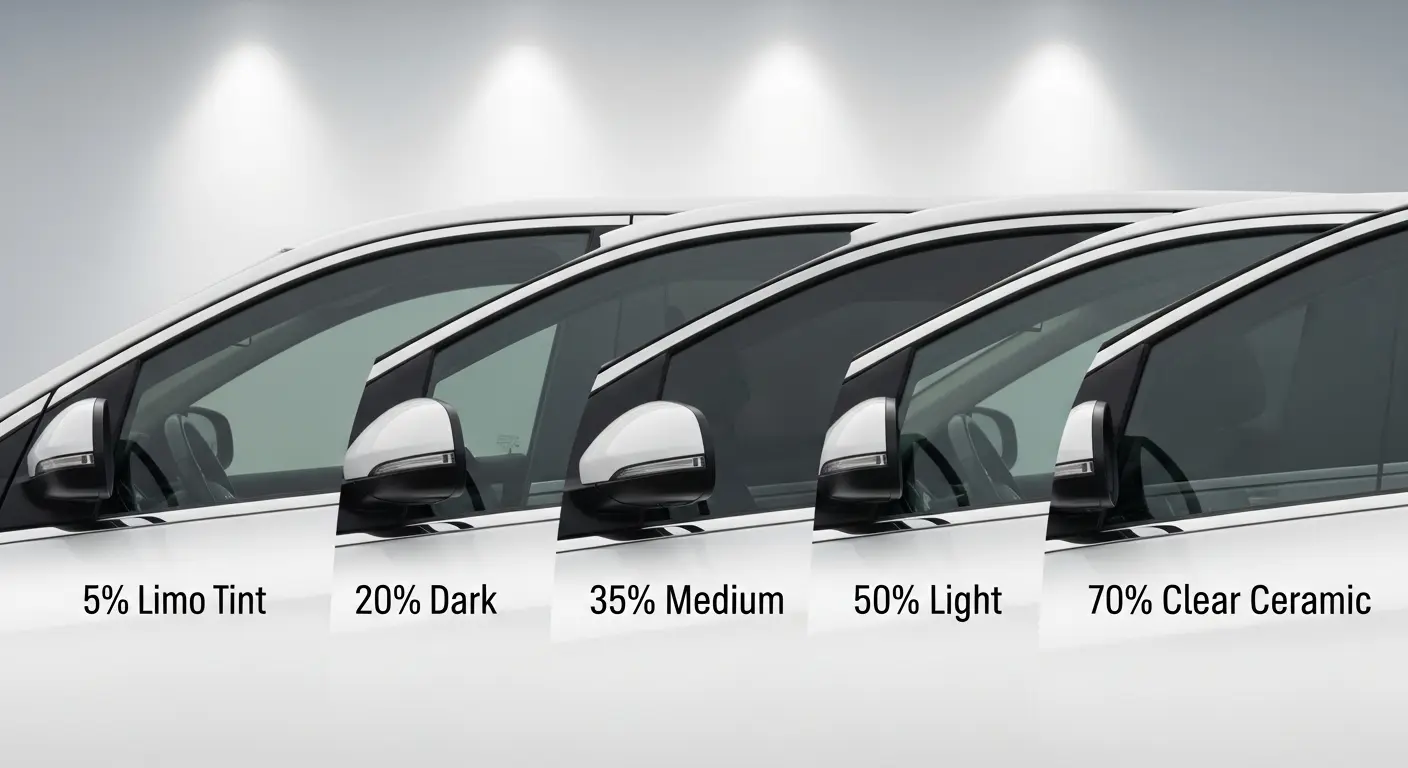
Walking into a window tint shop without understanding shade levels is like ordering food in a language you don't speak. You might get lucky, or you might end up with something you never wanted. Window tint shades are measured by VLT — Visible Light Transmission — a percentage that tells you exactly how much sunlight passes through the film and glass combined. A 5% tint blocks 95% of visible light, creating a near-blackout effect. A 70% tint allows most light through, appearing almost clear to the naked eye.
Here in Sacramento, where summer temperatures routinely push past 105 degrees and the Central Valley sun is relentless from May through October, the tint shade you choose has real consequences. It affects your cabin temperature, your energy consumption, your privacy, your nighttime visibility, and whether you'll pass a California traffic stop without a citation. At Quality Window Tinting, we've spent 20+ years helping Sacramento drivers navigate these choices — and this guide distills everything we've learned into one comprehensive resource.
Whether you're searching for the darkest legal option, the best tint percentage for heat rejection, or just trying to understand what "5 percent tint" actually looks like on a car, this guide covers every shade level in detail. We'll walk through appearance, legality in California, performance characteristics, and real-world recommendations based on thousands of installations at our Sacramento shop.
Understanding VLT: The Science Behind Window Tint Shades
VLT stands for Visible Light Transmission, and it is the universal measurement standard used by film manufacturers, professional installers, and law enforcement to describe how dark a tint is. The number represents the percentage of visible light that passes through the combined window film and glass. A lower VLT percentage means a darker tint that blocks more light, while a higher percentage means a lighter tint that allows more light to pass through.
One critical detail most people overlook: your factory glass already has a VLT rating. Most automotive glass allows approximately 70% to 80% of visible light through before any aftermarket film is applied. When you add window film, the VLT values multiply together. If your factory glass transmits 75% of light and you apply a 35% VLT film, your actual combined VLT is roughly 26% (0.75 x 0.35 = 0.2625). This means the tint will appear slightly darker than the film's rated percentage once installed.
The International Window Film Association (IWFA) establishes testing standards that ensure VLT measurements are consistent across different manufacturers. Law enforcement officers use handheld tint meters that measure VLT on the spot during traffic stops, so the combined value of your glass plus film is what determines legal compliance — not the film's standalone rating.
5% VLT — Limo Tint: The Darkest Available Shade
Five percent tint is the darkest commercially available window film, and it earns its "limo tint" nickname for good reason. At this level, only 5% of visible light enters through the glass, blocking a full 95%. From the outside, windows appear virtually black — you cannot see into the vehicle under any normal lighting condition. Even at close range in direct sunlight, the interior is almost entirely obscured.
Appearance: Jet black from the exterior. The windows become mirrors during the day, reflecting surrounding scenery rather than revealing anything inside. At night, passengers can see some light sources outside, but overall visibility is extremely limited.
California legal status: 5% tint is NOT legal on front side windows in California. It is, however, fully legal on rear side windows and the rear window. Under California Vehicle Code 26708, front side windows must allow at least 70% VLT. Installing 5% on front windows will result in a fix-it ticket and a failed vehicle inspection.
Heat rejection with ceramic: When paired with ceramic film technology, 5% VLT provides the maximum possible solar heat rejection. Premium ceramic 5% films can block up to 97% of infrared heat — a significant advantage during Sacramento's punishing summers. However, even basic dyed film at 5% provides strong heat reduction simply because so little light energy enters the cabin.
Best use case: Rear windows only. Popular on limousines, executive sedans, luxury SUVs, and vehicles where maximum privacy is the primary concern. Many Sacramento customers with home-based businesses who carry equipment in their vehicles choose 5% on the rear to deter break-ins.
Best for: Drivers who prioritize absolute privacy over rear visibility, limousine and town car operators, rideshare drivers wanting to separate front and rear compartments visually, and anyone who keeps valuables in their vehicle regularly. If you have a backup camera and rarely need to see directly through your rear window, 5% is a viable option.
15% VLT — Very Dark: Strong Privacy Without Full Blackout
Fifteen percent tint occupies the space between limo tint and the more commonly requested 20% shade. It blocks 85% of visible light, creating a very dark appearance that provides excellent privacy while allowing slightly more visibility than 5%. Most people cannot distinguish between 15% and 20% from the outside without a tint meter, but the driver notices the difference from behind the wheel — especially at night.
Appearance: Very dark from the exterior, approaching the look of limo tint. Interior contents are virtually invisible during daylight hours. In certain lighting angles, someone standing very close might see vague outlines, but details remain hidden. The visual difference between 15% and 5% is subtle to outside observers.
California legal status: Like 5%, 15% tint is NOT legal on front side windows in California. It is legal for rear side windows and the rear window with no restrictions. If your rear visibility is reduced, California law requires dual side mirrors — which all modern vehicles already have.
Heat rejection with ceramic: Ceramic film at 15% VLT delivers outstanding infrared rejection, typically in the 90-95% range for premium products. Because 15% blocks most visible light, the total solar energy rejected is very high. For Sacramento drivers battling triple-digit heat, ceramic 15% on rear windows creates a dramatically cooler cabin compared to untinted glass.
Best use case: Rear windows on vehicles where the driver wants near-limo privacy but with slightly better nighttime rear visibility. A common configuration is 15% on rear side windows with 20% on the rear window, or 15% all around the rear for a uniform appearance.
Best for: Drivers who want something darker than 20% but find 5% too extreme for rear visibility. Good for truck and SUV owners who rely on backup cameras and side mirrors rather than direct rear-window visibility. Also popular with drivers who commute on I-5 or Highway 50 through Sacramento and want maximum sun protection during long drives.
20% VLT — Dark Tint: The Most Popular Choice for Rear Windows
Twenty percent tint is the single most requested shade at our Sacramento shop, and it has been for years. It strikes an exceptional balance between privacy, aesthetics, and usability. At 20% VLT, 80% of visible light is blocked, creating a distinctly dark appearance that transforms any vehicle's look while still allowing the driver to see out with reasonable clarity — even at night.
Appearance: Dark and sleek from the exterior. During the day, it is very difficult to see the vehicle's interior. At night, interior lights make passengers somewhat visible, but in normal driving conditions, the cabin remains private. Twenty percent tint gives vehicles a clean, custom look that enhances virtually every color and body style — from a black sedan to a white SUV.
California legal status: 20% VLT is NOT legal on front side windows in California. It is fully legal on rear side windows and the rear window. This is worth emphasizing because 20% is so popular that some drivers assume it must be legal everywhere — it is not. Front windows must meet the 70% VLT minimum under California inspection standards.
Heat rejection with ceramic: A premium ceramic film at 20% VLT typically rejects 85-95% of infrared heat, depending on the manufacturer and product line. Even a mid-grade carbon film at 20% provides meaningful heat reduction. The combination of significant light blocking and advanced ceramic nano-technology makes 20% ceramic the go-to choice for Sacramento drivers who park outdoors and deal with the full force of Central Valley sun.
Best use case: All rear windows. The 20/70 combination — 20% on all rear glass, 70% ceramic on the front — is the most common legal configuration we install. It provides a strong visual statement, excellent heat rejection throughout the vehicle, and full California compliance.
Best for: Daily drivers who want meaningful privacy and sun protection without sacrificing too much nighttime visibility. Ideal for anyone who parks on the street or in open lots (common throughout Sacramento, Citrus Heights, and Rancho Cordova), commuters dealing with long sun exposure, and drivers who want their vehicle to look sharp without going extreme.
35% VLT — Medium Tint: The Versatile All-Around Performer
Thirty-five percent tint is the industry's sweet spot — the shade that consistently satisfies the widest range of drivers. It blocks 65% of visible light, enough to make a noticeable visual difference and provide genuine privacy, but not so much that nighttime visibility becomes a concern. For drivers who are tinting their vehicle for the first time and feel uncertain about going too dark, 35% is the safest bet.
Appearance: Noticeably tinted with a medium-dark appearance. From the outside during the day, you can see vague shapes inside the vehicle but cannot make out details or identify passengers clearly. The tint is immediately visible — no one will mistake it for factory glass — but it does not look aggressive or extreme. It gives vehicles a polished, professional aesthetic.
California legal status: 35% VLT is NOT legal on front side windows in California. However, it is completely legal for rear side windows and the rear window. Despite being darker than allowed on the front, 35% is a very common choice for rear windows and is well within the range that law enforcement considers normal for rear glass.
Heat rejection with ceramic: Ceramic film at 35% VLT provides impressive heat rejection — typically 80-90% of infrared heat depending on the product. Here is something important to understand: the difference in heat rejection between 20% ceramic and 35% ceramic is smaller than most people expect. A top-tier 35% ceramic film can reject nearly as much heat as a 20% ceramic film because the infrared-blocking nano-particles work independently of visible light transmission. This is why we tell Sacramento customers that film type matters more than shade for heat performance.
Best use case: Rear windows for drivers who want the best blend of form and function. Also an excellent choice for the rear windows of family vehicles where passengers (especially children) need to see out comfortably. Many customers choose 35% on the rear sides and 20% on the rear window for a graduated look.
Best for: First-time tinters, drivers who frequently drive at night, families with children who need visibility from the back seat, and anyone who wants a noticeable upgrade without committing to a very dark appearance. Also popular with drivers who move between California and states with stricter tint enforcement.
50% VLT — Light Tint: Subtle Protection with Maximum Visibility
Fifty percent tint is the lightest shade that produces a visible darkening effect on your windows. It allows half of the visible light through, creating a subtle, understated appearance that many drivers describe as an "OEM-plus" look — as if the car came from the factory with slightly darker glass. It does not scream "aftermarket tint," but it is definitely there.
Appearance: A gentle darkening that is most visible when comparing tinted windows directly against untinted glass on the same vehicle. The interior remains partially visible from the outside in daylight, though details are softened. The effect is refined and conservative — popular with luxury vehicle owners who want elegance over aggression.
California legal status: Like all shades below 70%, 50% VLT is NOT legal on front side windows in California. It is legal on all rear glass. However, 50% is close enough to the legal limit that it rarely draws attention from law enforcement, even when used on front windows (though we always recommend staying legal).
Heat rejection with ceramic: This is where ceramic technology truly shines. A 50% ceramic tint can reject 75-85% of infrared heat — remarkable performance from a nearly transparent film. For Sacramento drivers who want serious heat protection but dislike the look of dark tint, 50% ceramic is the answer. The heat rejection difference between 50% ceramic and 50% dyed film is enormous — the ceramic version will keep your cabin noticeably cooler while the dyed version provides minimal thermal benefit.
Best use case: Rear windows on vehicles where the owner wants a subtle look, or as a stepping stone for drivers new to tint who might go darker later. Also effective as an all-around shade for a uniform appearance when paired with 70% ceramic on the front.
Best for: Luxury and executive vehicle owners who prefer understated elegance, drivers with lighter-colored vehicles where dark tint may look too contrasting, professionals who need a conservative appearance, and anyone who prioritizes maximum visibility while still gaining UV and heat protection.
70% VLT — Near-Clear: The Only Legal Option for California Front Windows
Seventy percent VLT is the lightest tint shade and the only aftermarket option that is legal for front side windows in California. To the casual observer, 70% tint is nearly invisible — the windows appear clear. But do not let the lack of visible darkening fool you. When applied using ceramic film technology, 70% VLT provides genuine, measurable benefits that make a real difference in Sacramento's extreme heat.
Appearance: Almost identical to untinted glass. Most people cannot tell that 70% film has been applied by looking at the windows. There may be a very slight color shift depending on the film, but the windows remain fully transparent for all practical purposes. The film is essentially invisible.
California legal status: 70% VLT is the maximum darkness permitted on front side windows under California Vehicle Code 26708. It is also legal on all other windows. Because factory glass already transmits approximately 70-80% of light, the combined VLT of glass plus film may measure slightly below 70% — this is accounted for in enforcement, and quality installers like us use films specifically calibrated for California compliance.
Heat rejection with ceramic: This is where 70% ceramic becomes essential rather than optional. A premium 70% ceramic film can reject 60-80% of infrared heat while remaining virtually invisible. Without ceramic technology, a 70% film provides almost no heat reduction — it is the ceramic nano-particles doing the heavy lifting, not the shade. For Sacramento front windows, ceramic 70% is not a luxury; it is a necessity for anyone who spends time in traffic on I-80, Highway 50, or Business 80 during summer.
Best use case: Front side windows on all vehicles in California. Also used on windshields (on the legal visor strip area) and occasionally on rear glass for vehicles where the owner wants maximum visibility with UV protection only.
Best for: Every California driver. Seriously — if you are not going to tint your rear windows, at least put 70% ceramic on your front windows. It blocks 99% of UV rays (protecting your skin and interior), rejects significant infrared heat, and reduces glare — all while remaining completely legal and invisible. It is the single highest-value tinting investment you can make for daily driving comfort.
Window Tint Shades Comparison Chart
The table below compares all six common window tint shades across key performance metrics. Use this as a quick reference when deciding which shade level is right for your vehicle.
| Shade (VLT) | Light Blocked | Privacy Level | Night Visibility | Heat Rejection (Ceramic) | CA Front Legal |
|---|---|---|---|---|---|
| 5% (Limo) | 95% | Maximum | Very Poor | 95-97% | No |
| 15% | 85% | Very High | Poor | 90-95% | No |
| 20% | 80% | High | Fair | 85-95% | No |
| 35% | 65% | Moderate | Good | 80-90% | No |
| 50% | 50% | Low | Very Good | 75-85% | No |
| 70% | 30% | None | Excellent | 60-80% | Yes |
*Heat rejection percentages reflect infrared rejection with premium ceramic film. Dyed and metalized films will perform significantly lower at every shade level.
California Window Tint Laws: What Shades Are Legal?
California has some of the strictest window tint regulations in the United States, governed by California Vehicle Code Section 26708. Understanding these laws is essential before choosing a shade, because the wrong choice on the wrong window will cost you money and hassle.
- Front windshield: Non-reflective material only, bottom edge ≥29" above the undepressed driver's seat per CVC 26708(c)(1) — usually near the manufacturer's AS-1 line, roughly the top 4 to 5 inches. No aftermarket tint is allowed below that line.
- Front side windows: Must allow at least 70% VLT. This means only near-clear film (70% or lighter) is legal. Ceramic 70% is the best option for these windows.
- Rear side windows: Any shade is legal. You can install 5% limo tint with no legal consequences.
- Rear window: Any shade is legal, provided the vehicle has dual side mirrors (standard on all modern vehicles).
Violations carry a base fine of approximately $25, but court fees and surcharges typically push the total to $100-$200. Repeat offenses carry higher penalties and may affect your vehicle inspection results. More importantly, illegal front tint gives law enforcement probable cause to pull you over, which creates unnecessary encounters and potential complications.
The most popular legal configuration among our Sacramento customers is 70% ceramic on the front side windows with 20% or 35% on all rear glass. This setup provides whole-vehicle heat rejection, strong rear privacy, a sleek aesthetic, and complete California legal compliance.
How Shade Interacts with Film Type: The Performance Gap Most People Miss
Here is the most important thing most drivers do not understand about window tint: the same shade in different film types performs dramatically differently. A 35% dyed film, a 35% carbon film, and a 35% ceramic film will look identical from the outside — they all block 65% of visible light. But their heat rejection, UV protection, clarity, and longevity are worlds apart.
Dyed film at any shade provides color and privacy but minimal heat rejection. The dye absorbs some solar energy and re-radiates it as heat — sometimes making the glass itself hot to the touch. Dyed films also fade over time, turning purple after a few years of Sacramento sun exposure.
Carbon film represents a meaningful upgrade. Carbon particles reflect infrared radiation rather than absorbing it, providing moderate heat rejection (40-60% of infrared) while maintaining a matte-black appearance that does not fade. Learn more in our carbon vs ceramic tint comparison.
Ceramic film is the gold standard. Ceramic nano-particles reject 80-97% of infrared heat at any shade level, do not interfere with phone signals or GPS, will not fade, and provide the clearest optical quality. A 50% ceramic tint rejects more heat than a 20% dyed tint — making shade selection about appearance preference rather than performance compromise.
The takeaway: choose your shade for aesthetics and privacy, then choose ceramic film for performance. Do not go darker than you want simply to get better heat rejection — that is the wrong approach. Go with the shade you like and let the film technology handle the heat.
Sacramento-Specific Shade Recommendations
Sacramento presents a unique set of challenges for window tinting. The Central Valley climate features extreme summer heat (regularly exceeding 105 degrees from June through September), intense UV exposure rated "Very High" to "Extreme" by the EPA for much of the year, and bright, direct sunlight that creates significant cabin heat even in spring and fall. Combined with long commute times (the average Sacramento driver spends 27 minutes each way), the right tint setup makes a measurable difference in comfort and vehicle protection.
Based on our 20+ years of experience tinting vehicles in Sacramento, Roseville, Folsom, Elk Grove, and the surrounding region, here are our top recommendations:
- Maximum heat protection: 70% ceramic front + 20% ceramic rear. This is the optimal legal setup for Sacramento summers. You get invisible heat rejection on the front and strong privacy plus heat blocking on the rear.
- Balanced comfort and style: 70% ceramic front + 35% ceramic rear. Great all-around choice for drivers who want noticeable tint without going very dark. Excellent nighttime visibility with meaningful heat reduction.
- Maximum privacy: 70% ceramic front + 5% rear sides + 20% rear window — our standard privacy tint setup. Provides complete rear privacy while keeping the rear window functional for visibility. Popular with drivers in areas like North Highlands and Arden Arcade where vehicle break-ins are a concern.
- Subtle and professional: 70% ceramic front + 50% ceramic rear. Barely-there appearance with genuine thermal performance. Preferred by professionals who need a conservative vehicle appearance.
Shade Recommendations by Vehicle Type
Sedans (Camry, Accord, Model 3, Civic)
Sedans have relatively small rear window areas, which means darker tints have a proportionally larger impact on visibility. Most sedan owners find 35% provides the ideal balance — noticeable enhancement without the nighttime visibility trade-off that comes with 20%. For luxury sedans (Mercedes, BMW, Lexus), 20% on the rear gives a commanding, executive appearance that matches the vehicle's premium character.
SUVs and Crossovers (RAV4, Highlander, Model Y, Tahoe)
SUVs benefit enormously from tinting because of their large glass area. More glass means more solar heat entering the cabin, and SUV tinting can reduce cabin temperature by 15-20 degrees on a Sacramento summer day. The elevated seating position compensates somewhat for reduced visibility in darker shades. We recommend 20% for most SUV owners — it looks proportional to the vehicle's size and provides excellent privacy for the cargo area.
Trucks (F-150, Silverado, Ram, Tacoma, Tundra)
Trucks are where darker shades truly shine. The bold, aggressive styling of modern trucks pairs perfectly with 20% or even 15% tint. Most truck drivers rely on side mirrors rather than rear window visibility, making darker shades practical as well as aesthetic. Crew cab trucks with four full-size doors benefit from consistent tinting across all rear glass at 20% — it creates a cohesive, muscular look that complements the truck's presence.
Tesla and Electric Vehicles
Tesla and EV owners have a unique consideration: cabin heat directly impacts battery range because the air conditioning draws from the same battery that powers the motor. Every degree cooler the cabin stays without AC is range preserved. For this reason, we strongly recommend ceramic film on all windows for EV owners. The most popular Tesla configuration is 70% ceramic front, 20% or 35% ceramic rear, and the optional full windshield visor strip. Model Y and Model X owners with their panoramic glass roofs especially benefit from rear tinting.
Does Shade Affect Window Tinting Cost?
Here is good news: the shade or VLT percentage you choose has little to no impact on the cost of window tinting. A 20% tint and a 50% tint from the same film product line cost the same to purchase and install. The shade is simply a manufacturing variable — the base material, technology, and production process are identical regardless of whether the film transmits 5% or 70% of light.
The factors that do affect pricing are:
- Film type: Ceramic costs more than carbon, which costs more than dyed film. This is the primary price differentiator.
- Vehicle size: Larger vehicles with more glass area require more material and labor time.
- Number of windows: Full vehicle tinting costs more than rear-only.
- Window complexity: Curved, multi-piece, or unusually shaped windows require more skill and time to install.
- Existing tint removal: If old tint needs to be removed first, that adds to the total cost.
This means you should choose your shade based purely on your aesthetic and functional preferences — not on price. Pick the VLT level that looks right and works right for your driving habits, then invest in the best film type your budget allows (ceramic being our strong recommendation for Sacramento conditions).
Ready to Choose Your Perfect Tint Shade?
Our experienced installers can show you samples of every shade level on your actual vehicle at our Sacramento shop. See the difference between 20%, 35%, and 50% with your own eyes before committing. We will walk you through the options, explain how each shade looks with your specific paint color and interior, and help you make a confident decision.
Call us at (916) 282-2577 or request a free quote online.
Frequently Asked Questions About Window Tint Shades
What is the darkest legal window tint in California?
In California, the darkest legal tint for front side windows is 70% VLT, which allows 70% of visible light through. There is no darkness limit for rear side windows or the rear window — you can legally go as dark as 5% (limo tint) on all rear glass. The windshield may carry non-reflective material only above a line measured 29 inches above the undepressed driver's seat (CVC 26708(c)(1)) — usually near the AS-1 line, roughly the top 4 to 5 inches.
What does the window tint percentage number mean?
The percentage refers to Visible Light Transmission (VLT) — the amount of visible light that passes through the film and glass combined. A lower number means darker tint: 5% VLT blocks 95% of light (very dark), while 70% VLT blocks only 30% (very light). Factory glass typically has around 70-80% VLT before any aftermarket film is applied.
Is 20% or 35% tint better for Sacramento heat?
For heat rejection specifically, the film type matters more than the shade. A 35% ceramic tint can reject more heat than a 20% dyed tint. That said, darker shades do block more visible light and solar energy overall. For Sacramento summers with 100-degree-plus temperatures, we recommend ceramic film at whichever shade you prefer for aesthetics — you will get excellent heat rejection at either 20% or 35%.
Can I put 5% limo tint on my entire car in California?
No. California law (CVC 26708) requires front side windows to allow at least 70% VLT. You can legally install 5% limo tint on rear side windows and the rear window only. Putting 5% on front windows will result in a fix-it ticket, and you will fail a California vehicle inspection. Many customers choose 5% on the rear and 70% ceramic on the front for a legal setup.
Does darker window tint cost more than lighter tint?
Generally, no. The shade or VLT percentage has minimal impact on the price of window tinting. The primary cost factor is the type of film — ceramic tint costs more than carbon, which costs more than dyed film. A 20% ceramic tint and a 50% ceramic tint from the same product line will typically cost the same. The film type, vehicle size, and number of windows determine the final price.
Window Tint Shade Consultations in Sacramento
Quality Window Tinting provides expert window tint shade selection and professional installation throughout the greater Sacramento area. Visit our shop to see every shade level in person before making your decision.
Would you rather just see it?
There is a limit to how well words describe how dark something looks. Move a slider through every VLT level instead, day or night, with California's legal limit flagged as you go.
Open the shade visualizer →Related Window Tinting Guides
Ceramic Window Tinting
Why ceramic film is the best choice for Sacramento heat and how it outperforms every other film type.
Best Window Tint Percentage
Deep dive into 20% vs 35% vs 50% with pros, cons, and real-world comparisons.
California Tint Laws
Complete breakdown of CVC 26708, legal limits by window, fines, and medical exemptions.